Digital twins and device shadows
A connected device is often asleep, out of coverage or busy. Applications still need to read its state and change its settings. A device shadow (Microsoft calls it a device twin) solves this with a copy of the device’s state in the cloud, which applications can always reach. The device and the shadow catch up with each other whenever the device connects.
A digital twin is the broader idea: a model of a physical thing, kept in step with it, that can be queried, analysed or simulated. A shadow is the simplest kind of digital twin.
Desired and reported state
The shadow holds two views of the same settings:
- Desired: what applications want the device to be. Written by the cloud side.
- Reported: what the device says it is. Written only by the device.
The difference between them (the delta) is the work the device still has to do.
{
  "state": {
    "desired":  { "reportIntervalSeconds": 300, "firmware": "2.4.1" },
    "reported": { "reportIntervalSeconds": 900, "firmware": "2.4.0", "battery": 71 }
  },
  "version": 42,
  "timestamp": 1760000000
}
A shadow document with a pending change to two settings.
The reconciliation loop
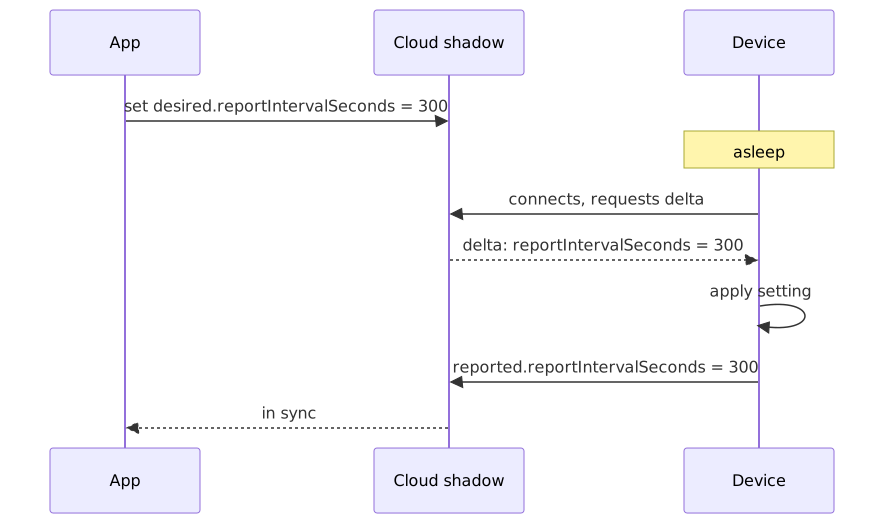
A setting applied the next time the device wakes.
The device applies what it can and reports what it actually did. If a setting is invalid, it reports its real value and, ideally, an error field, so the delta stays visible rather than being silently ignored.
Getting the details right
- Versions: every update carries the version it was based on, and the service rejects stale updates. This stops two writers overwriting each other.
- Idempotency: the device may receive the same delta twice. Applying it again must do no harm. See idempotency.
- Size: keep the shadow to configuration and a small summary of status. Telemetry belongs in a time-series store, not in the shadow.
- Ownership: only the device writes
reported; only applications writedesired. Mixing them makes the state impossible to reason about. - Commands are different: “reboot now” is not a state. Use a command or job mechanism for one-off actions.
Implementations
| Option | Notes |
|---|---|
| AWS IoT Device Shadow | Shadows over MQTT topics; named shadows for separate concerns |
| Azure IoT Hub device twins | Desired and reported properties, plus tags for querying fleets |
| Eclipse Ditto | Open-source digital twin service for self-hosted platforms |
| LwM2M | The server’s view of each device’s objects plays the same role; see LwM2M |
| W3C Web of Things | A standard Thing Description format for describing what a device offers |
Common ways to implement shadows and twins.
Where next
- Edge computing for IoT covers where the reconciliation logic can run.
- The Handbook covers device management architecture in more depth.