Transport and network security
Edge devices transmit mission-critical telemetry and receive remote actuation commands over public, unmonitored networks (cellular 4G/5G, Wi-Fi, Ethernet, LoRaWAN, satellite). Network communication must assume an untrusted transport medium vulnerable to eavesdropping, packet modification, and man-in-the-middle (MitM) interception.
1. Mutual TLS (mTLS 1.3) Architecture
Standard web TLS only authenticates the server to the client. In connected systems, Mutual TLS (mTLS) is mandatory: both the cloud ingress gateway and the edge device cryptographically prove their identities to each other before any application data is exchanged.
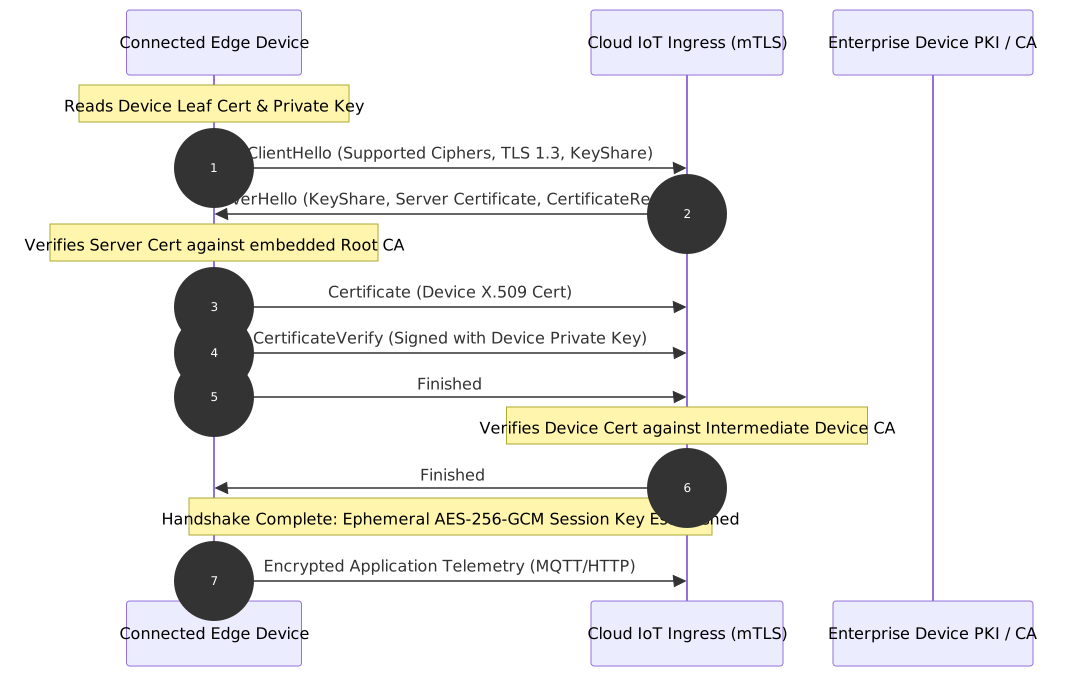
Why TLS 1.3 is Mandatory over TLS 1.2
- Zero Insecure Ciphers: TLS 1.3 permanently eliminates vulnerable legacy algorithms (RC4, 3DES, CBC mode ciphers, MD5, SHA-1, static RSA key exchange).
- Mandatory Forward Secrecy: Every connection negotiates ephemeral Diffie-Hellman keys (
ECDHE). Even if a device’s long-term private key is extracted years later, previously recorded network traffic cannot be decrypted. - Faster Handshake: Handshake overhead is reduced from two round trips (2-RTT) to one round trip (1-RTT), saving battery power and cellular bandwidth.
2. Public Key Infrastructure (PKI) for IoT Fleets
A scalable, secure X.509 Public Key Infrastructure requires strict hierarchical separation:

Key Provisioning Guidelines
- Never Share Private Keys: Each device must generate or be injected with a unique, cryptographically distinct private key. Shared symmetric passwords across a fleet are strictly prohibited.
- ECC over RSA: Use Elliptic Curve Cryptography (
secp256r1ored25519) instead of 2048/4096-bit RSA. A 256-bit ECC key delivers equivalent security to a 3072-bit RSA key with an 85% smaller payload, saving flash space and computational battery life. - Air-Gapped Root CA: The Root CA must never be directly connected to the internet. It exists exclusively to sign Intermediate CAs and CRLs, stored in tamper-proof Hardware Security Modules (HSMs).
3. Automated Certificate Enrolment (EST & SCEP)
Manual certificate injection during field deployment does not scale and introduces human operational risks. Devices should leverage Enrolment over Secure Transport (EST, RFC 7030):
- Bootstrap Phase: The factory injects an initial Manufacturer Device Identity certificate (IDevID, IEEE 802.1AR) tied to the hardware Root of Trust.
- First Cloud Contact: The device boots, connects to the provisioning server using its IDevID, and issues a Certificate Signing Request (CSR) via EST over HTTPS.
- Operational Issuance: The PKI validates the hardware identity, generates an operational Local Device Identity certificate (LDevID), and installs it securely on the device.
- Automated Renewal: Before certificate expiration (for example, 30 days remaining), the firmware automatically requests a renewed leaf certificate via EST without requiring manual physical servicing.
4. Secure Application Protocols
MQTT over TLS (Port 8883)
MQTT is the dominant publish-subscribe protocol for resource-constrained edge telemetry.
| Feature | Standard (Unsafe) MQTT | Hardened Enterprise MQTT Standard |
|---|---|---|
| Port & Wire Security | Port 1883 (Plaintext TCP) | Port 8883 (Encrypted mTLS 1.3) |
| Client Authentication | Static username/password | Client X.509 certificate subject matching Common Name (UUID) |
| Topic Authorisation | Unrestricted wildcards (#, +) |
Fine-grained Access Control Lists (ACLs) per device UUID |
| Topic Namespace | Global shared topics (sensors/data) |
Isolated tenancy: devices/{client_id}/telemetry |
| Payload Integrity | Unchecked raw bytes | Protobuf / JSON schema with optional HMAC-SHA256 signature |
CoAP over DTLS (RFC 7252 / RFC 7925)
For extremely resource-constrained devices communicating over UDP, Constrained Application Protocol (CoAP) secured with Datagram Transport Layer Security (DTLS 1.2 / 1.3) provides: - Low-overhead binary message headers (4 bytes base header). - Connection ID (CID) support to survive network NAT rebinding and IP address changes without renegotiating full handshakes. - Pre-shared Key (PSK) or lightweight raw public key (RPK) cipher suites where full X.509 certificate chains exceed packet MTU limits.
5. Network Microsegmentation & Zero Trust Edge
Connected devices must operate under a Zero Trust architecture:
- No Inbound Open Ports: Devices must never listen on open public TCP/UDP ports (for example, Telnet or unauthenticated HTTP servers). All communication channels must be outbound connections initiated by the device toward cloud endpoints.
- Local Interface Isolation: If a device includes multiple network interfaces (for example, an Ethernet port for an industrial sensor bus and a cellular modem for cloud reporting), the interfaces must be strictly isolated via kernel network namespaces and packet filtering rules (
iptables/nftables). Bridging or forwarding packets between untrusted local networks and enterprise networks is forbidden. - DNS-over-TLS (DoT) / DNSSEC: Guard against DNS poisoning and redirect attacks by encrypting DNS lookups or using hardcoded, verified server public keys.