B
B2B
Business-to-business. Trade between businesses, such as a manufacturer buying parts or a retailer buying stock, as opposed to selling to consumers.
See also: B2C.
B2C
Business-to-consumer. Selling goods or services directly to the people who use them.
See also: B2B.
Backhaul
The links that connect the edge of a network, such as mobile cell sites or exchange equipment, back to the core. Commercially, it also means wholesale capacity bought from another operator for that purpose.
See also: RAN, Leased Line.
Backlog
An ordered list of everything that might be needed to deliver an outcome, such as a product. The items at the top are the most valuable and the best understood.
See also: Backlog Grooming, Product Owner, User Stories.
Backlog Grooming
Regular work by the product owner and the team to keep the backlog in order. They add and remove items, prioritise them, and break down the items at the top so they are ready to start. It is also called backlog refinement.
See also: Backlog, Definition of Ready.
Bandwidth
In networking, the maximum rate at which data can cross a path, in bits per second. In signal processing and radio, it means the range of frequencies a signal occupies, in hertz.
Baseline
An agreed version of an artefact that later work builds on. Changes to a baselined artefact go through change control.
See also: Change Control, Configuration Management.
Bash
The GNU Project’s Unix shell, a free replacement for the Bourne shell first released in 1989. It is the default shell on most Linux distributions.
See also: Sh, Ksh, Csh, Shell Scripting.
BASIC
Beginner’s All-purpose Symbolic Instruction Code. A family of high-level languages designed in 1964 at Dartmouth College to be easy to learn. It was the language most home computers of the 1980s started with.
See also: VB.
BAU
Business as usual. The normal day-to-day running of an organisation, as opposed to projects that bring change.
BDD
Behaviour-Driven Development. A practice in which the team describes how a system should behave through concrete examples, often in the Given, When, Then form, and uses them as automated tests.
See also: Gherkin, Given When Then, TDD, ATDD.
Bench Test
A test run in the development environment on the part of the system being worked on.
See also: Unit Testing, Developer Integration Test.
BER
Basic Encoding Rules. The original encoding rules for ASN.1, in which each value is written as a type, a length and the value itself. BER allows several encodings of the same value.
See also: ASN.1, CER, DER, TLV.
Best Practice
A practice or technique that experience shows to work well for a given goal or risk.
BFF
Backend for Frontend. An architecture pattern in which each kind of client, such as a mobile app or a web app, has its own server-side gateway. The gateway shapes the data and calls that client needs from the services behind it.
See also: Microservice, API.
BGCF
Breakout Gateway Control Function. In IMS, the SIP server that decides where a call leaves the IMS network for the circuit-switched telephone network, based on the dialled number.
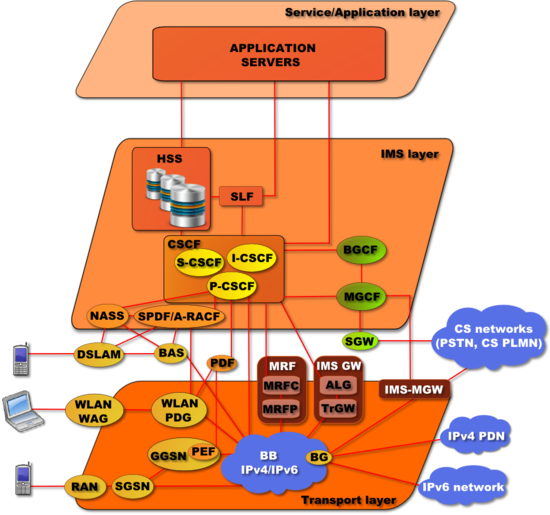
BGCF.
BGP
Border Gateway Protocol. The routing protocol that exchanges reachability information between autonomous systems on the internet. It is a path vector protocol, and routes are chosen by policy as well as by path.
Bjarne Stroustrup
The Danish computer scientist who created C++.
See also: C++.
Black-Box Testing
Testing a system through its interfaces, without looking at how it is built. Also called Functional Testing.
Bluetooth
A short-range radio standard in the 2.4 GHz band for connecting devices such as headsets, keyboards and phones into personal area networks. The Bluetooth Special Interest Group manages it.
BNF
Backus-Naur Form. A notation for writing the grammar of a language as a set of production rules. Extended BNF (EBNF) and augmented BNF (ABNF), the variant used in RFCs, add shorthand for repetition and options.
BNG
Broadband Network Gateway. The router at the edge of a broadband provider’s network that terminates subscriber sessions, applies policy and passes their traffic on to the provider’s IP network. It is the successor to the BRAS.
BOOTP
Bootstrap Protocol. An early protocol, defined in RFC 951, with which a device gets an IP address and boot information from a server when it starts. DHCP grew out of it and uses the same UDP ports, 67 and 68.
Boston Matrix
A two-by-two chart that sorts a company’s products by market share and market growth into stars, cash cows, question marks and dogs. It helps decide where to invest. It is also called the growth-share matrix.
Bottom-Up Estimation
Estimating a system by breaking it into small pieces, estimating each one, and adding up the results.
See also: Top-Down Estimation, Decomposition Estimation, Work Breakdown Structure.
BPEL
Business Process Execution Language. An OASIS XML language for describing business processes as orchestrations of web service calls. It is also written WS-BPEL.
BPMN
Business Process Model and Notation. A graphical notation, maintained by the Object Management Group, for drawing business processes. Version 2.0 also defines how the diagrams execute.
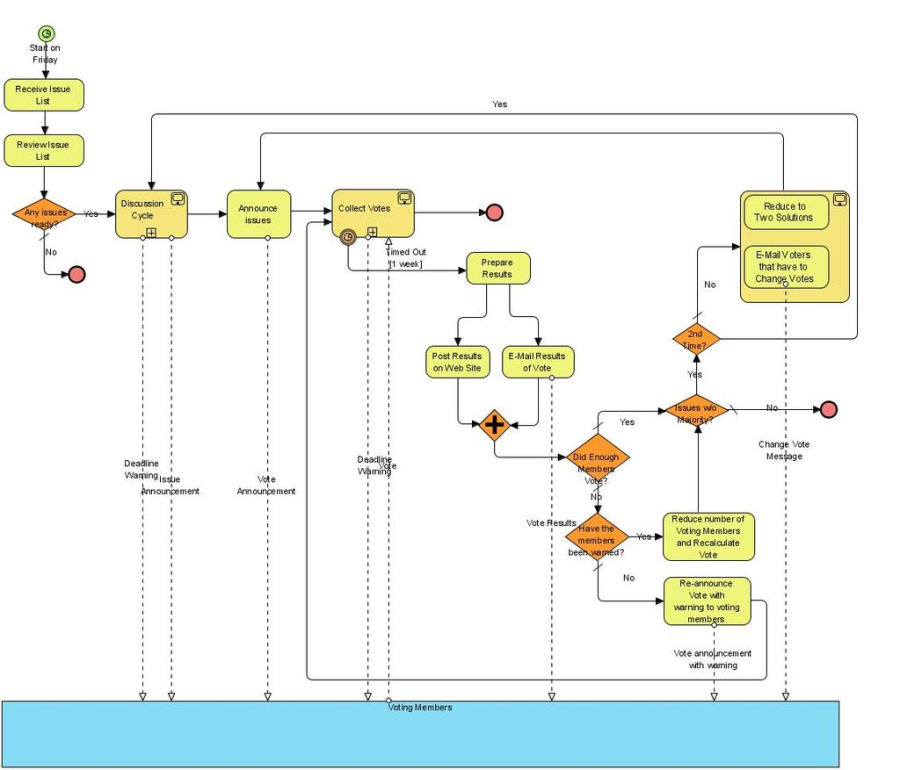
BPMN.
BRAS
Broadband Remote Access Server. The router that aggregates broadband sessions from DSLAMs and routes them on to the internet service provider’s network. Newer designs call it a BNG.
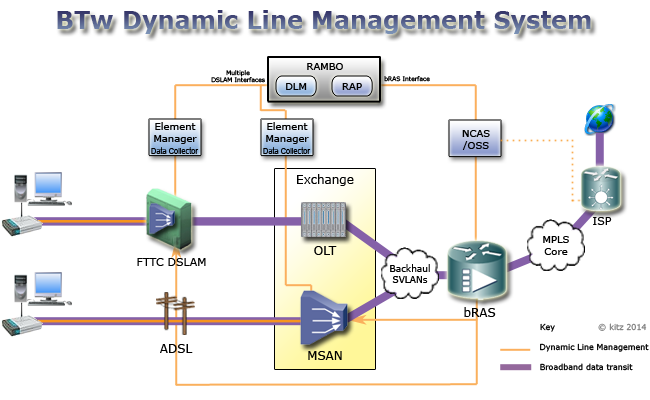
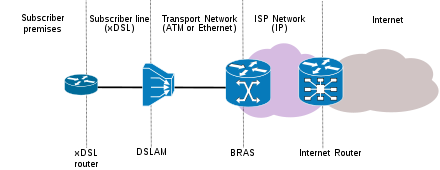
BRAS.
BRAS.
BRI
Basic Rate Interface. The ISDN access for homes and small businesses. It has two 64 kbit/s bearer (B) channels for voice or data and one 16 kbit/s D channel for signalling, often written 2B+D. In the UK, BT sold it as ISDN2.
Broadcast
Sending a message to every receiver on a network segment at once, such as an Ethernet broadcast to all hosts on a LAN.
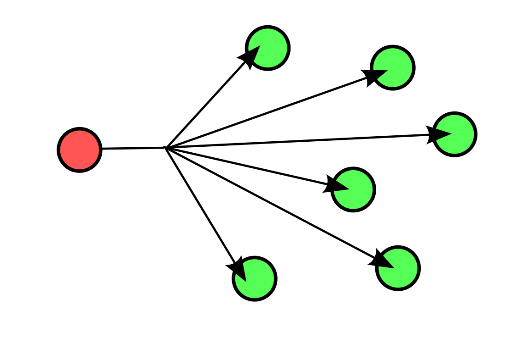
Broadcast.
See also: Unicast, Multicast, Anycast.
BSC
Base Station Controller. In GSM, the node that controls a group of base transceiver stations: it allocates radio channels, manages handovers between them, and concentrates their traffic towards the MSC.
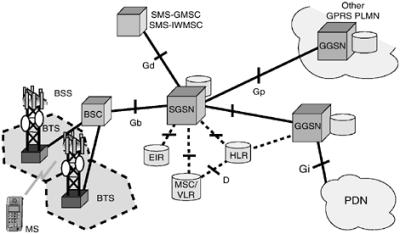
BSC.
BSS
Business Support Systems. The systems a telecoms operator uses to run its business with customers, such as ordering, billing and customer management. They sit beside the operations support systems (OSS). In mobile networks, BSS also stands for base station subsystem: the BTSs and BSCs.
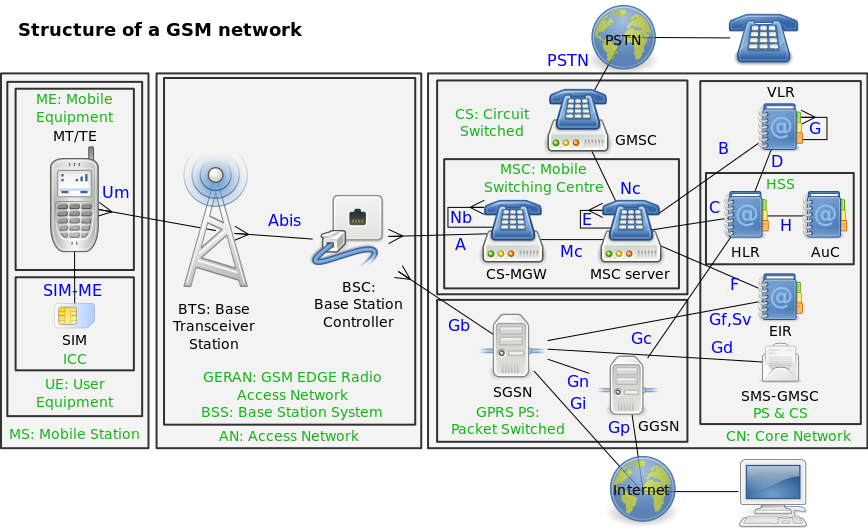
BSS.
See also: OSS.
BT 21CN
BT 21st Century Network. BT’s programme, from the mid-2000s, to replace its separate legacy networks with one IP and MPLS network, using multi-service access nodes (MSANs) in exchanges. The plan to move voice onto it was shelved at the time; the later switch-off of the PSTN finishes that job.
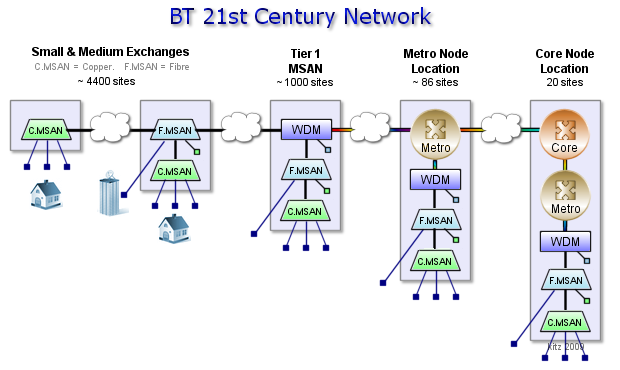
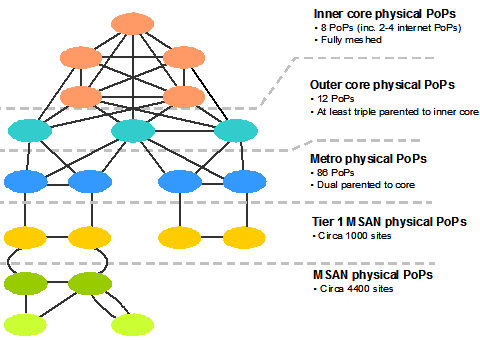
BT 21CN.
BT 21CN.
BTNUP
BT National User Part. BT’s variant of ISDN user part signalling. See IUP.
BTS
Base Transceiver Station. The radio equipment at a GSM cell site that talks to mobile phones. In UMTS the equivalent is the Node B, and in LTE the eNodeB.
See also: BSC, Node B, E NodeB.
Bug
A fault in software that makes it behave other than intended.
See also: Defect.
Build
The process that turns source code and other assets into a runnable system. The word also means the result: a version of the system ready to test.
See also: Automated Build, Build Environment.
Build Environment
A separate environment kept for making builds, usually on one or more dedicated build machines.
See also: Build Machine, Development Environment.
Build Machine
A computer used only to make software builds.
See also: Build Environment.
Build tool
A tool that automates building software, such as Make, Maven or Gradle.
See also: Build.
Burndown Chart
A chart that shows the work remaining in an iteration or project against time. A burnup chart shows the work completed instead.
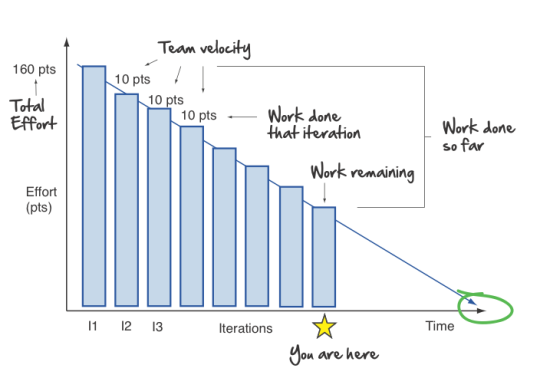
Burndown Chart.
Burst
A short transmission at a high rate, or a group of errors that arrive close together.
Business Agility Ownership
Business agility is an organisation’s ability to notice change, inside or outside it, and respond quickly enough to keep delivering value to its customers.
See also: Agile.
Business Requirement
A high-level goal of the organisation or customer asking for a system: why it is wanted. Also called a Why Requirement.
See also: Requirement, Functional Requirement.
Business Schedule
A high-level schedule of a project’s main milestones and the business goals tied to them. It sets the top-down limits that the detailed schedule must fit.
See also: Detailed Schedule, Milestone.
BYOD
Bring Your Own Device. A policy that lets staff use their own laptops, tablets and phones for work, including access to company systems and data. It brings security and support questions that the policy needs to answer.