R
R Language
A language and free environment for statistical computing and graphics, widely used by statisticians and data scientists.
See also: Python.
RACI
Responsible, Accountable, Consulted, Informed. A responsibility matrix that sets out, for each task or deliverable, who does the work, who is accountable for it, who is consulted and who is kept informed.
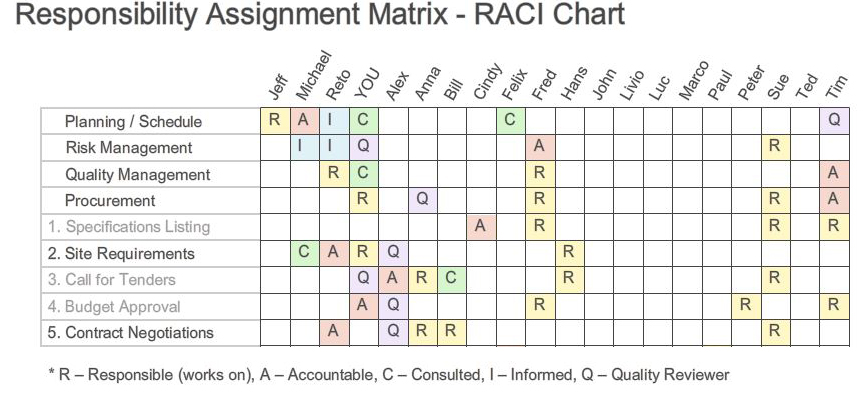
RACI.
RAD
Rapid Application Development. An approach that develops software quickly through prototypes, workshops, early user testing and component reuse, with less formal documentation.
See also: Rapid Application Development, DSDM, Joint Application Development.
RAD Environment
A development tool that combines a language and an IDE with a toolbox of ready-made user interface components, for building applications quickly.
Radius
RADIUS: Remote Authentication Dial-In User Service. The protocol (RFC 2865) that network access servers use to authenticate users, authorise their access and record their usage against a central server. It is widely used for broadband, Wi-Fi and VPN access.
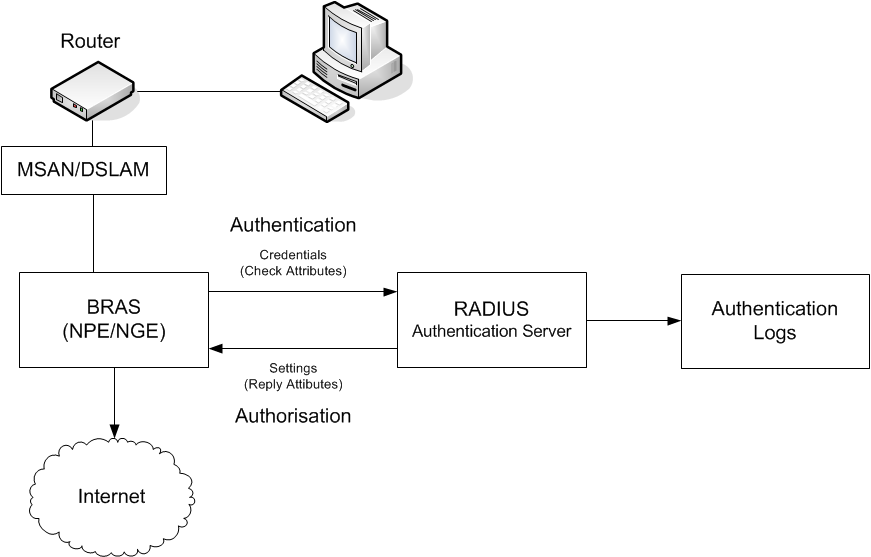
Radius.
RAN
Radio Access Network. The part of a mobile network between devices and the core: the base stations and their controllers. GERAN, UTRAN and E-UTRAN are the 2G, 3G and 4G versions.
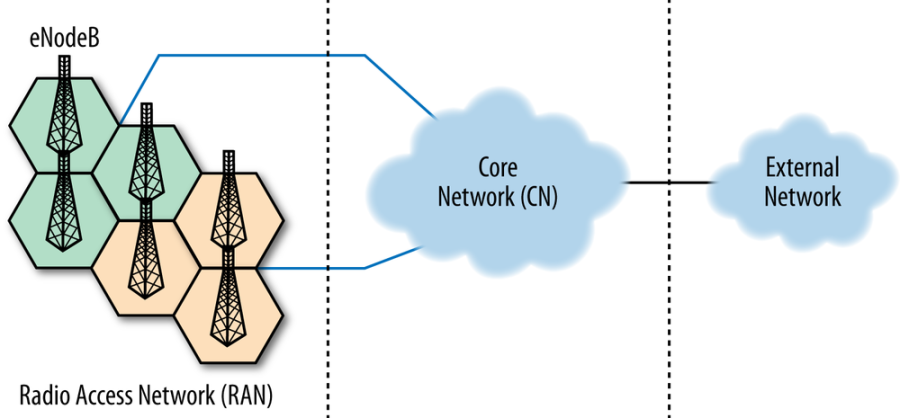
RAN.
See also: GERAN, UTRAN, E-UTRAN, Backhaul.
RANAP
Radio Access Network Application Part. The UMTS signalling protocol on the Iu interface between the radio access network (the RNC) and the core (MSC or SGSN).
RANCID
Really Awesome New Cisco confIg Differ. An open-source tool that logs in to network devices, collects their configurations, stores them in version control and reports changes.
Rapid Application Development
See RAD.
RARP
Reverse Address Resolution Protocol. An obsolete protocol (RFC 903) with which a device that knows only its MAC address asks a server for its IP address. BOOTP and DHCP replaced it.
RAS
Registration, Admission and Status. The part of H.323 (in H.225) with which endpoints register with a gatekeeper and ask permission to make calls. RAS also stands for remote access server.
See also: H.323.
RDBMS
Relational Database Management System. A database system based on Edgar Codd’s relational model, which stores data in tables with rows and columns and is queried with SQL.
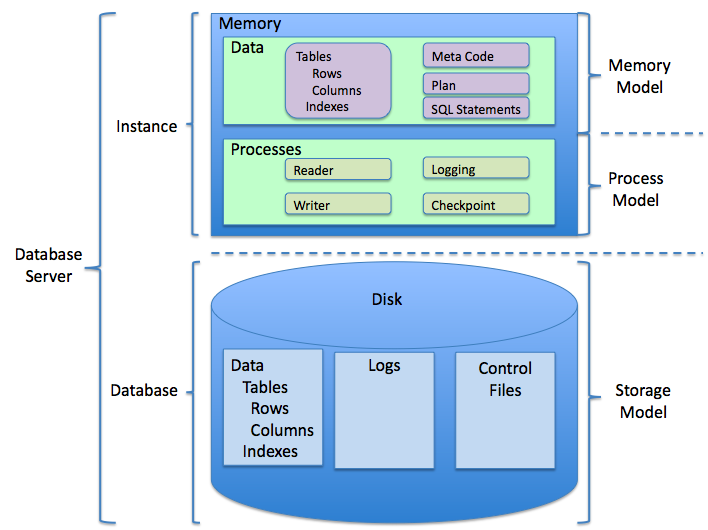
RDBMS.
RDP
Remote Desktop Protocol. Microsoft’s protocol for using another computer’s desktop over a network, on TCP and UDP port 3389.
Reading Inspection
An inspection that follows every step of the full process except the inspection meeting.
See also: Inspection.
Refactoring
Improving the internal structure of code without changing what it does, in small steps backed by tests.
See also: Technical Debt, TDD.
Regression testing
Re-running tests after a change to check that what worked before still works.
See also: Automated Testing.
Regular expression
A pattern that describes a set of strings, used to search, match, validate and replace text. It is also called a regex.
Relative Estimation
Estimating work by comparing items with each other, or grouping items of similar difficulty, rather than estimating each in absolute units.
See also: Points, T-Shirt Sizing.
Release
Delivering a deployable version of a system to a customer, such as a test group or end users. The word also means the version delivered.
See also: Release Management, Product Release.
Release Management
Identifying, packaging and delivering the parts of a product to its customers, internal or external.
See also: Release, Semantic Versioning.
Release Test
A test that checks software is ready for release.
Requirement
A statement of something a system must do, or a quality it must have.
See also: Functional Requirement, Non-functional Requirement.
Requirements
The work of finding out, recording and managing what a software system should do.
See also: Requirement, Software Requirements Specification.
Requirements Lead
The person responsible for defining, maintaining and tracing a product’s requirements, and for the user documentation that follows from them.
REST
Representational State Transfer. An architecture style for web services in which resources are identified by URLs and handled through a uniform set of stateless operations, usually the HTTP methods. GET reads, POST creates, PUT replaces and DELETE removes.
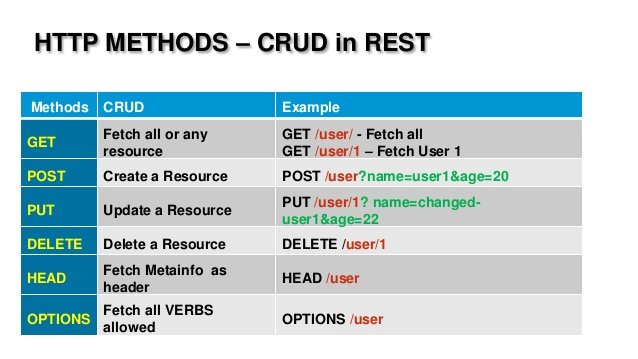
REST.
Review
A defined process in which people other than an artefact’s author examine it to find issues. Reviews range from informal desk checks to formal inspections.
See also: Inspection, Desk Check, Walkthrough.
Reviewer
A person who takes part in a review.
See also: Review.
Revision
One recorded version of an artefact, usually as numbered by a version control system.
See also: Version Control.
Revision Control
See Version Control.
Rework
Unplanned work needed to bring an artefact into line with the project’s needs, such as fixing defects.
See also: Update.
RFC
Request for Comments. The IETF’s numbered document series, which includes the internet’s standards and many informational and experimental documents.
See also: IETF.
RIP
Routing Information Protocol. One of the oldest distance-vector routing protocols. It uses hop count as its metric, with a limit of 15 hops, so it suits only small networks.
Risk
A possible future event that would harm a project’s features, budget, schedule or quality if it happened.
See also: Risk Management, Risk List.
Risk Analysis
Assessing each risk for its likelihood and impact.
See also: Risk Management.
Risk Identification
Finding and recording a project’s current risks.
See also: Risk Management.
Risk List
A list of a project’s current and past risks, with their analysis and mitigation plans.
See also: Risk Management, Extrinsic Risk Management.
Risk Management
Identifying, analysing and controlling a project’s risks, either explicitly or as part of how the project is run.
See also: Risk, Extrinsic Risk Management, Intrinsic Risk Management, Risk Mitigation.
Risk Mitigation
Planning and taking action to reduce a risk’s likelihood or impact.
See also: Risk Management.
Risk Reward Matrix
A two-by-two grid for comparing options, with risk on one axis and reward on the other. High-reward, low-risk options are the best candidates; high-risk, low-reward ones are to be avoided. The size of each marker can show the resources each option needs.
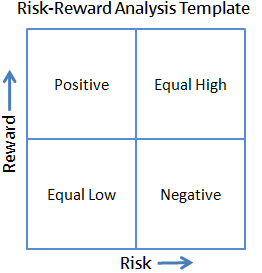
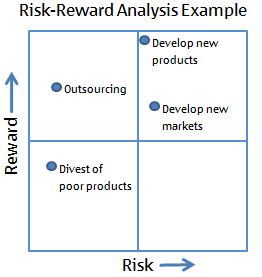
Risk Reward Matrix.
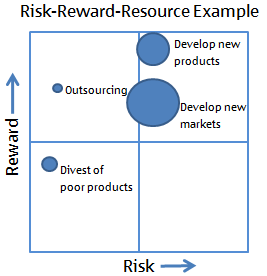
Risk Reward Matrix.
Risk Reward Matrix.
RNC
Radio Network Controller. The UMTS node that controls a group of Node Bs. It manages radio resources and handovers, and ciphers user data. It connects to the circuit-switched core through the Iu-CS interface and to the packet core through Iu-PS.
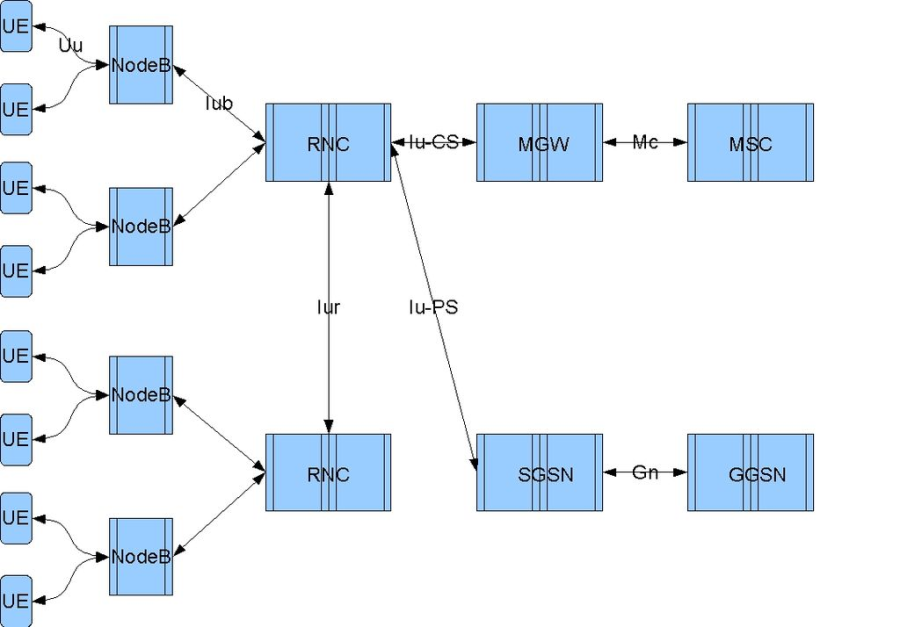
RNC.
See also: Node B, UTRAN, RANAP, BSC.
RNSAP
Radio Network Subsystem Application Part. The UMTS signalling protocol between RNCs, on the Iur interface, used for soft handover and moving a connection from one RNC to another.
Role-feature-reason
The usual template for writing user stories: “As a role, I want feature, so that reason.”
See also: User Stories.
Rolling Wave Planning
Planning the near future in detail and later work only roughly, then adding detail as each period comes closer.
See also: Project Headlights, Progressive Elaboration.
Root of Trust
RoT. The hardware, firmware and keys that a device trusts without checking, because everything else is checked against them. It anchors secure boot, device identity and key storage, and is usually built into the chip or a secure element.
See also: RoT, Secure Element, TrustZone.
RoT
See Root of Trust.
Round Robin
A scheduling method that gives each task or queue a turn in a fixed circular order, with equal time slices and no priorities. It is simple and no task is starved.
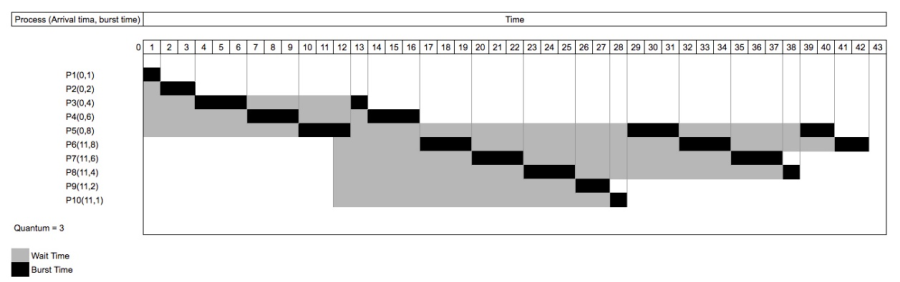
Round Robin.
See also: Scheduler, Preemption.
Router
A device that forwards packets between networks, choosing the next hop for each from its routing table, which it builds from configuration and routing protocols.
See also: Switch, Control Plane, BGP, OSPF.
RPC
Remote Procedure Call. Calling a procedure that runs in another process or on another machine as if it were a local call, with the messaging hidden by the framework.
See also: JSON-RPC, XML-RPC, SOAP.
RRC
Radio Resource Control. The 3GPP control protocol between a device and the radio network in UMTS, LTE and 5G. It sets up and releases connections and radio bearers, broadcasts system information and manages mobility. A state machine, with idle and connected states, governs the device.
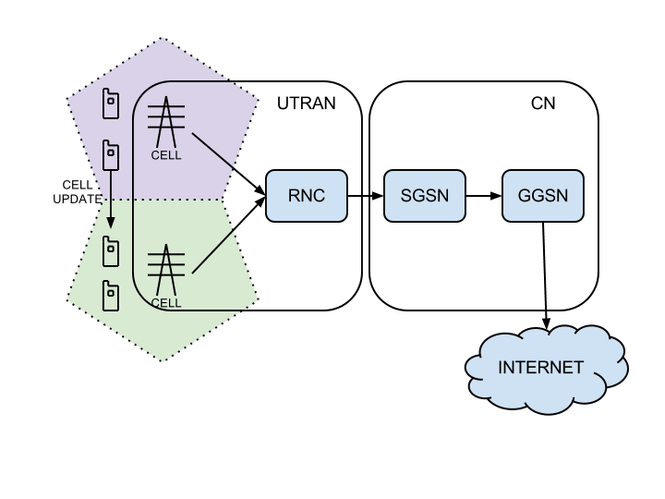
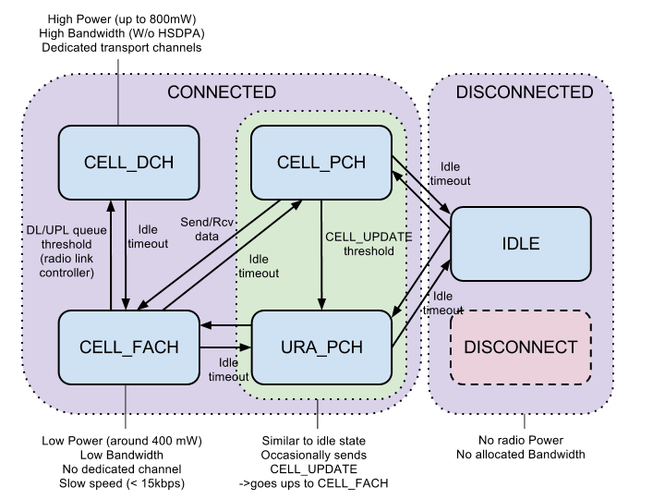
RRC.
RRC.
RSTP
Rapid Spanning Tree Protocol. IEEE 802.1w, a faster version of the spanning tree protocol that recovers from a topology change in seconds rather than tens of seconds. It is now part of 802.1D.
See also: STP.
RSVP
Resource Reservation Protocol. A protocol (RFC 2205) with which receivers reserve network resources for a flow along its path. Its extension, RSVP-TE, sets up traffic-engineered MPLS paths.
RTCP
RTP Control Protocol. The companion to RTP, defined in RFC 3550. It reports statistics on an RTP session, such as packet loss, jitter and round-trip time, and helps synchronise streams.
See also: RTP.
RTOS
Real-Time Operating System. An operating system that guarantees tasks respond within defined time limits, usually by priority-based preemptive scheduling. FreeRTOS, Zephyr and VxWorks are examples.
See also: Scheduler, Preemption, MCU.
RTP
Real-time Transport Protocol. The protocol (RFC 3550) that carries audio and video over IP, usually on UDP, with sequence numbers and timestamps so receivers can play media out smoothly. SIP or another protocol sets up the session.
RTSP
Real Time Streaming Protocol. A protocol for controlling streaming media servers with commands such as play, pause and record. The media itself usually travels over RTP.
See also: RTP.
Ruby
A dynamic, object-oriented scripting language created by Yukihiro Matsumoto in the mid-1990s, designed to make programmers productive and happy.
See also: Ruby on Rails.
Ruby on Rails
A web application framework written in Ruby, built on the model-view-controller pattern and known for “convention over configuration”.
See also: Ruby.
Rule of Simplicity
Kent Beck’s rules, in priority order, for judging whether code is simple enough: it passes the tests, reveals its intent, has no duplication and has the fewest elements.
See also: Simple Design, KISS Principle.
RUP
Rational Unified Process. An iterative software development process framework from Rational Software (later IBM), with four phases: inception, elaboration, construction and transition.
See also: UML, Iterative Development.