Leveraging a Technology Radar for Strategic Decision-Making in Business
In the fast-moving world of technology, businesses often struggle to stay ahead of emerging trends while balancing technical debt, legacy systems, and innovation. A Technology Radar is a practical tool for tracking technologies, frameworks, platforms, and methodologies—helping businesses make informed decisions about what to adopt, trial, assess, or hold off on.
I maintain a personal Technology Radar to track trends and technologies relevant to my areas of interest. But the same concept can be incredibly useful for organisations looking to align their technology strategy with their business goals.
Why Businesses Should Maintain a Technology Radar
1. Avoiding Hype-Driven Development
Technology trends can be noisy. One moment, a new framework is "the future," and the next, it’s abandoned. A Technology Radar helps separate genuine innovation from passing fads, ensuring investment in tools and techniques that provide real value.
2. Aligning Tech with Business Objectives
A well-maintained Radar isn’t just about cool tech—it should be tied to business goals. Whether improving developer efficiency, reducing cloud costs, or ensuring regulatory compliance, technologies should be assessed based on their impact on the bottom line.
3. Encouraging Continuous Learning & Innovation
A Radar fosters a culture of innovation by encouraging teams to assess new technologies in a structured way. It provides visibility into what’s being explored across the organisation, reducing silos and duplication of effort.
4. Managing Technical Debt Proactively
Technical debt is inevitable, but a Radar helps businesses track legacy dependencies and make strategic decisions about modernisation. Rather than reacting when systems become unmanageable, businesses can plan phased transitions to better technologies.
How to Structure a Business Technology Radar
A Technology Radar typically consists of four quadrants:
- Languages & Frameworks – Programming languages, libraries, and frameworks used in software development.
- Tools & Platforms – DevOps tools, cloud providers, IDEs, and deployment strategies.
- Techniques & Practices – Architectural approaches, coding standards, and methodologies.
- Infrastructure & Deployment – Cloud-native strategies, serverless computing, edge computing, and CI/CD pipelines.
Each item falls into one of four categories:
- Adopt – Proven, recommended technologies with clear business benefits.
- Trial – Emerging technologies worth experimenting with in controlled environments.
- Assess – Promising but unproven technologies requiring further research.
- Hold – Technologies that should be phased out or avoided due to risks or obsolescence.
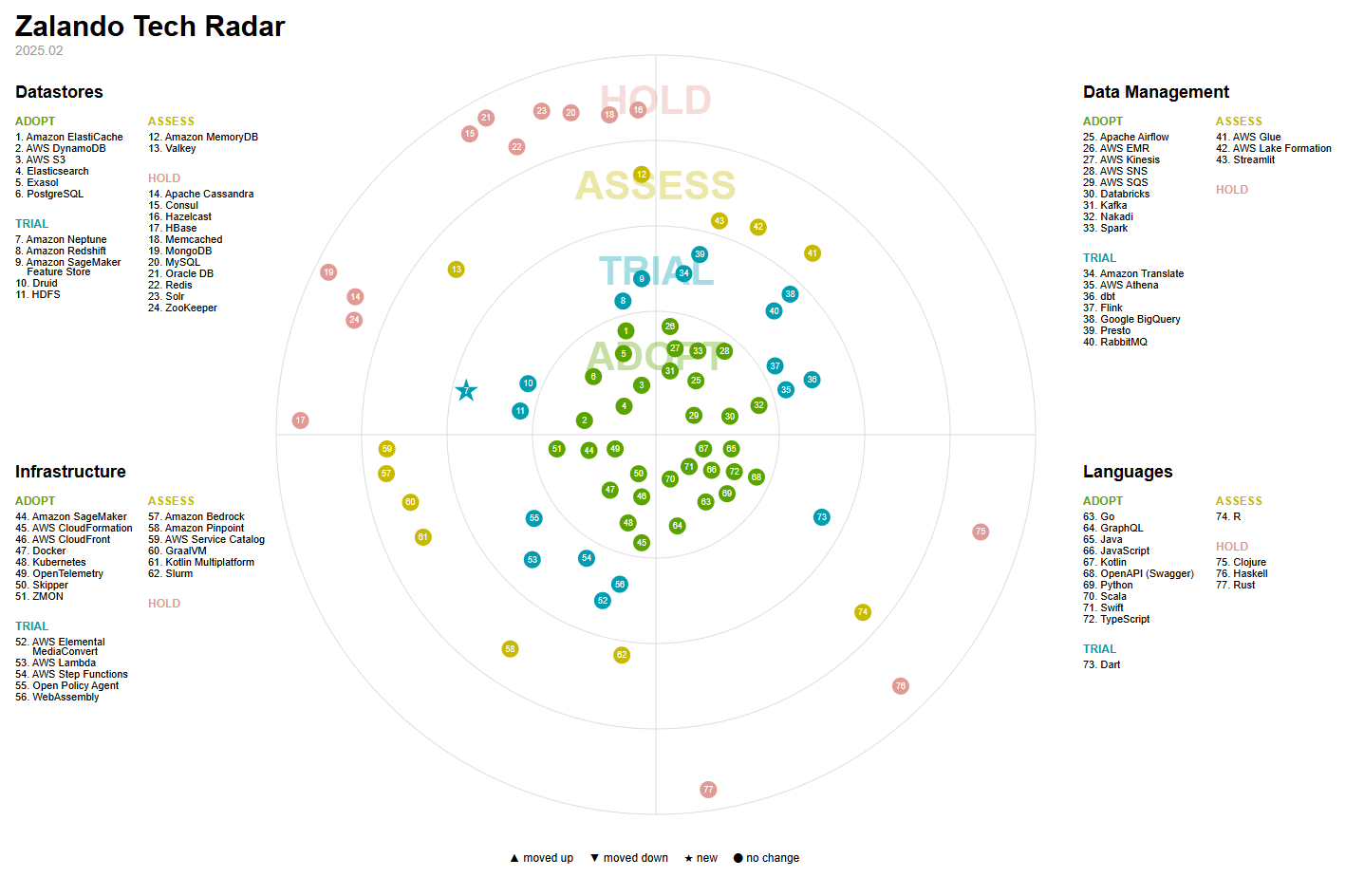
Image of the Zalando Tech Radar.
How Often Should You Update a Technology Radar?
A Technology Radar should be a living document, but it shouldn’t change so frequently that it becomes noise. A quarterly update cycle is a good balance—frequent enough to capture new trends but structured enough to encourage meaningful discussions.
- Every quarter, review the Radar with key stakeholders (engineering leadership, architects, tech leads).
- Annually, do a larger strategic review: Are we seeing patterns? Are there tech trends we need to rethink?
- Ad-hoc updates can happen when a major tech shift occurs—such as a key vendor ending support for a product or a new security risk emerging.
What Influences the Decision to Add or Remove Technologies?
Adding or removing technologies from the Radar shouldn't be arbitrary—it should be driven by data, experience, and alignment with business needs. Here are some key factors:
Adding a Technology
- Industry Trends – New frameworks, tools, and best practices emerging in the wider ecosystem.
- Business Needs – Does this technology solve a problem the business is facing (scalability, security, cost, etc.)?
- Developer Experience – Will it improve productivity, maintainability, or reduce complexity?
- Technical Experiments – Have internal trials or prototypes demonstrated value?
- Competitive Advantage – Will adopting this technology help differentiate the company’s products or services?
Removing a Technology
- Becomes Business-as-Usual (BAU) – Once a technology is widely used and no longer a strategic decision, it can be removed from the Radar. The Radar should focus on emerging decisions, not everyday tools.
- Obsolescence – If a framework, tool, or practice is no longer maintained, has security risks, or is being deprecated, it should be flagged for removal.
- No Longer Fits Business Strategy – Technologies that were promising but don't align with long-term goals should be phased out.
- Poor Adoption or Negative Feedback – If a technology was trialled but didn’t provide the expected benefits, it should be removed.
What Happens When You Stop Using a Technology?
Deciding to stop using a technology is just as important as choosing to adopt one. Businesses need a structured approach to deprecating technologies to avoid chaos.
-
Document the Reason for Stopping
-
Was it technical debt?
- Poor performance?
- Security vulnerabilities?
-
Industry shifts?
-
Plan a Transition Strategy
-
If the tech is core to systems, identify a replacement and create a migration plan.
-
If it’s a minor tool, ensure teams know what to use instead.
-
Communicate the Change
-
Developers and teams need to know what’s changing and why.
-
Provide timelines for removal and offer guidance on alternatives.
-
Archive for Historical Context
-
Keep a record of technologies that were removed and why—this prevents teams from revisiting past mistakes.
Implementing a Technology Radar in a Business
1. Define Ownership & Update Cadence
Decide who maintains the Radar—typically a Tech Leadership Group, Architecture Guild, or Engineering Council. A quarterly review cycle works well to keep it relevant without becoming a burden.
2. Encourage Team Contributions
Make it a collaborative effort. Encourage engineers, architects, and product teams to propose additions based on real-world experience. Crowdsourcing insights leads to better decision-making.
3. Make It Visual & Accessible
Use tools like ThoughtWorks Radar, Zalando’s Tech Radar generator, or custom dashboards to make the Radar easy to consume. Avoid static documents that get lost in Confluence or SharePoint.
4. Integrate with Decision-Making
A Radar is useless if it’s not referenced in architectural decisions. It should feed into tech strategy discussions, RFCs, and architectural decision records (ADRs).
5. Tie It to Business Outcomes
Don't track tech for the sake of it. Regularly ask:
- Does this help us scale?
- Does this reduce costs or improve developer experience?
- Does this align with regulatory and security needs?
Final Thoughts
A Technology Radar isn't just a nice-to-have—it’s a strategic asset. By systematically tracking technological trends and aligning them with business goals, organisations can stay ahead of disruption, reduce risks, and drive innovation with confidence.
If your company doesn’t have a Radar yet, now’s the time to start. Keep it lightweight, collaborative, and actionable, and it will become an invaluable tool in your technology strategy.