A Deep Dive into TCP: How It Powers Reliable Communication
Introduction
The Transmission Control Protocol (TCP) is one of the fundamental building blocks of the internet. It ensures that data is delivered accurately and in order, even when networks are congested or unreliable. Whether you're streaming a video, sending an email, or making an online payment, TCP is working behind the scenes to make sure your data reaches its destination intact.
In this deep dive, we’ll explore:
- How TCP establishes and tears down connections
- How data flows reliably between devices
- The TCP packet format
- Congestion control mechanisms
- Sliding windows and how TCP optimises performance
- A step-by-step breakdown with diagrams
Let’s get started. 🚀
1. TCP: A Reliable Transport Protocol
TCP operates at Layer 4 (Transport Layer) of the OSI model. It is a connection-oriented and reliable protocol, meaning it ensures:
- ✅ Order – Packets arrive in the correct sequence.
- ✅ Reliability – Lost packets are retransmitted.
- ✅ Error Detection – Corrupted data is discarded and re-sent.
- ✅ Flow Control – Prevents overwhelming the receiver.
- ✅ Congestion Control – Helps manage network congestion.
Unlike UDP (User Datagram Protocol), which sends data without guarantees, TCP establishes a connection between two devices before exchanging data. This process is known as the three-way handshake.
2. TCP Connection Setup: The Three-Way Handshake
Before data transfer can begin, TCP must establish a connection. This is done using the three-way handshake:
sequenceDiagram
    participant Client
    participant Server

    Client->>Server: SYN (Sequence Number = x)
    Server->>Client: SYN-ACK (Sequence Number = y, Acknowledgment = x+1)
    Client->>Server: ACK (Acknowledgment = y+1)
Step-by-step explanation
1️⃣ SYN (Synchronise): The client sends a TCP packet with the SYN flag set, indicating it wants to establish a connection. It also includes an Initial Sequence Number (ISN).\ 2️⃣ SYN-ACK (Synchronise-Acknowledge): The server responds with SYN-ACK, acknowledging the client's sequence number and sending its own ISN.\ 3️⃣ ACK (Acknowledge): The client sends an ACK to confirm the connection is established.
After this exchange, the connection is established, and data transfer can begin.
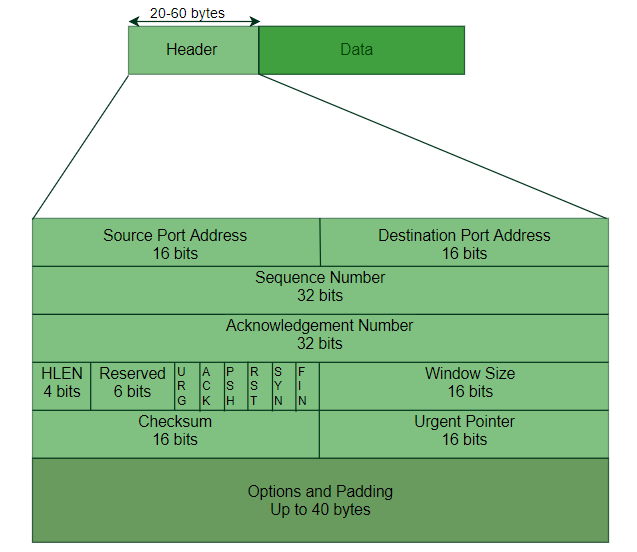
3. TCP Packet Format: Understanding the Header
A TCP packet consists of a header and a data section. The header contains important metadata that ensures proper transmission and reassembly.
TCP Header Structure
| Field | Size (bits) | Description |
|---|---|---|
| Source Port | 16 | Port of the sender |
| Destination Port | 16 | Port of the receiver |
| Sequence Number | 32 | Position of the first byte in the segment |
| Acknowledgment Number | 32 | The next expected byte from the other side |
| Data Offset | 4 | TCP header length |
| Reserved | 3 | Reserved for future use |
| Flags | 9 | Control flags (SYN, ACK, FIN, etc.) |
| Window Size | 16 | Flow control mechanism |
| Checksum | 16 | Ensures data integrity |
| Urgent Pointer | 16 | Marks urgent data |
| Options | Variable | Used for additional settings |
🖼 Diagram of a TCP Header
4. Data Transmission & Flow Control
Once the connection is established, TCP ensures reliable and efficient data transmission.
sequenceDiagram
    participant Sender
    participant Receiver

    Sender->>Receiver: Packet 1 (Seq=100, Ack=200)
    Sender->>Receiver: Packet 2 (Seq=200, Ack=300)
    Receiver->>Sender: ACK (Seq=300, Ack=400)
Each TCP segment includes:
- A Sequence Number (to order packets)
- An Acknowledgment Number (confirming received packets)
- A Window Size (for flow control)
TCP ensures reliability by retransmitting lost packets and handling out-of-order segments.
5. Sliding Window Protocol: Managing Flow Control
TCP uses a sliding window mechanism to control how much data can be in transit before needing an acknowledgment.
How it works
- The window size determines how many bytes can be sent before an acknowledgment is required.
- If the receiver has limited buffer space, it advertises a smaller window size.
- As data is acknowledged, the window slides forward, allowing more data to be sent.
🖼 Visual Representation of Sliding Window
sequenceDiagram
    participant Sender
    participant Receiver

    Sender->>Receiver: Send 4 packets (Seq 100-400, Window = 4)
    Receiver->>Sender: ACK (Seq=400, Window = 2)
    Sender->>Receiver: Send 2 more packets (Seq 400-600, Window = 2)
This mechanism prevents overwhelming the receiver while keeping the pipeline full for efficient throughput.
6. TCP Congestion Control: Avoiding Network Overload
TCP dynamically adjusts its sending rate based on network conditions using:
1⃣ Slow Start
- Starts with a small Congestion Window (cwnd).
- Doubles cwnd every round-trip time (RTT) to avoid overloading the network.
2⃣ Congestion Avoidance
- Once the threshold is reached, TCP increases cwnd linearly instead of exponentially.
3⃣ Fast Retransmit & Fast Recovery
- If a packet is lost (detected via duplicate ACKs), TCP immediately retransmits instead of waiting for timeout.
7. Connection Termination: The Four-Way Handshake
Closing a TCP connection is a graceful process that ensures all data is delivered before termination.
sequenceDiagram
    participant Client
    participant Server

    Client->>Server: FIN (Client wants to close)
    Server->>Client: ACK (Acknowledges FIN)
    Server->>Client: FIN (Server closes connection)
    Client->>Server: ACK (Final acknowledgment)
Step-by-step explanation
1️⃣ FIN – The client sends a FIN (Finish) packet.\ 2️⃣ ACK – The server acknowledges the FIN.\ 3️⃣ FIN – The server sends its own FIN packet.\ 4️⃣ ACK – The client acknowledges and the connection closes.
After termination, TCP enters a TIME_WAIT state to ensure all packets have been properly handled before releasing resources.
Conclusion
TCP is the backbone of reliable communication on the internet. From establishing a connection via the three-way handshake to managing congestion and flow control, it ensures that data reaches its destination accurately and efficiently.
Key Takeaways
- 🔹 TCP guarantees reliability, order, and error-checking.
- 🔹 It uses acknowledgments and retransmissions to handle lost packets.
- 🔹 Sliding windows optimise flow control and prevent congestion.
- 🔹 Congestion control mechanisms like Slow Start and Fast Retransmit keep the network stable.
Next time you browse the web or send a message, remember: TCP is quietly making sure your data gets where it needs to go. 🚀