OpenADR: Enabling Scalable, Automated Demand Response
Introduction
With the energy transition accelerating, grid operators and utilities need smarter, automated demand response (DR) to balance supply and demand. OpenADR provides a standardized way to automate DR, integrating utilities, aggregators, and consumers into a seamless, interoperable energy ecosystem.
This post covers:
- ✅ How OpenADR works (VTN, VEN, and Aggregators)
- ✅ Cloud and IoT architectures for OpenADR
- ✅ Security, scalability, and best practices
What is OpenADR?
Open Automated Demand Response (OpenADR) is an open standard that allows utilities, grid operators, and energy aggregators to automate Demand Response (DR) programmes. It does this through secure, real-time communication between energy providers and consumers.
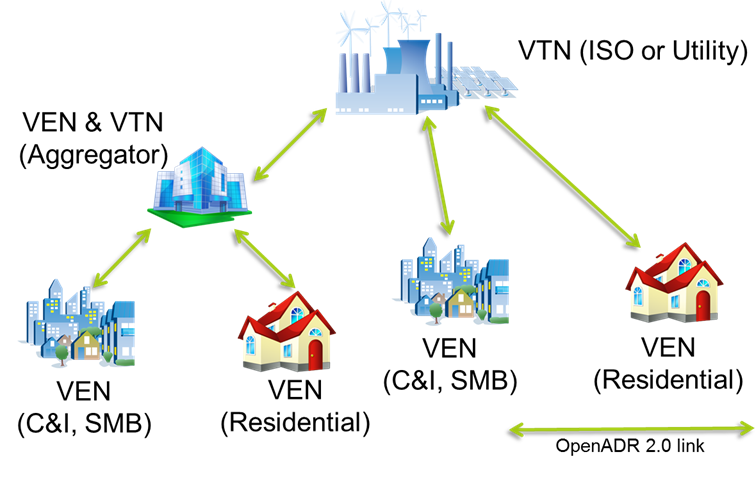
Key Participants in an OpenADR System
- 🔹 Virtual Top Node (VTN) – Issues DR events (e.g., utility or aggregator).
- 🔹 Virtual End Node (VEN) – Receives and responds to DR events (e.g., smart buildings, EV chargers, batteries).
- 🔹 Aggregators (VTN & VEN) – Play a dual role, receiving DR signals from utilities (as a VEN) and distributing them to customer devices (as a VTN).
OpenADR Communication Flow
1️⃣ Grid operator/utility (VTN) issues a DR event.\ 2️⃣ Aggregator (VTN & VEN) receives the event and optimizes distribution.\ 3️⃣ Customers & devices (VENs) adjust consumption based on pricing, signals, or direct control.
OpenADR 2.0b & 3.0: The Foundation of Modern Demand Response
🔹 OpenADR 2.0b is the most widely deployed version, supporting:
- Asynchronous DR event communication
- Price & event-based signals
- Telemetry & real-time energy reporting
🔹 OpenADR 3.0 is the API-driven evolution, built for:
- RESTful JSON APIs (easier integration)
- Scalability for cloud & edge
- Enhanced security with OAuth2 & JWT
Both versions support grid-scale DR programs, but OpenADR 3.0 enables faster, more flexible energy automation.
How OpenADR Fits in a Cloud-Native Energy System
OpenADR in a Cloud-Based Architecture
For large-scale grid operators, aggregators, and energy platforms, a cloud-based VTN can manage thousands of VENs dynamically.
- ✅ Scalability – Handle millions of DR events dynamically
- ✅ Real-time telemetry – Optimise energy demand based on grid conditions
- ✅ AI-driven forecasting – Predict DR needs and automate responses
Aggregators: The Bridge Between Utilities and Customers
Aggregators act as both VTNs and VENs, optimizing energy flexibility by managing multiple customers and devices.
- 🔹 As a VEN: Receives DR signals from utilities.
- 🔹 As a VTN: Distributes DR events to individual customers, buildings, and industrial loads.
💡 Example: EV Charging Aggregator
- Receives OpenADR events from a grid operator.
- Optimizes charging schedules across multiple EV fleets.
- Ensures grid stability by coordinating demand response at scale.
Security & Scalability Considerations
🔒 Security Best Practices in OpenADR
- ✅ OAuth 2.0 + JWT authentication – Prevents unauthorized access.
- ✅ Granular permission models – Restricts DR signals based on policy.
- ✅ End-to-end encryption (TLS 1.2+) – Ensures secure data exchange.
🌍 Scaling OpenADR Deployments
- ✅ Serverless VTNs – Auto-scale DR event handling.
- ✅ Event-driven architectures (Kafka, Pub/Sub) – Enables low-latency processing.
- ✅ Hybrid cloud + edge – Reduces latency for real-time DR.
Conclusion
🚀 OpenADR is revolutionizing demand response, providing a flexible, automated approach to managing energy demand at grid scale.
Key Takeaways
- ✅ OpenADR enables seamless DR automation for utilities, aggregators, and consumers.
- ✅ Aggregators play a key role in optimizing energy flexibility.
- ✅ OpenADR 3.0 is API-driven and built for the future.
- ✅ Security & scalability are critical for successful OpenADR deployments.
🔗 Want to explore OpenADR?