A Deep Dive into IP: The Backbone of Internet Communication
Introduction
The Internet Protocol (IP) is the foundation of modern networking. It is responsible for addressing, routing, and delivering data packets across the internet. Unlike TCP (Transmission Control Protocol), which ensures reliability, IP follows a best-effort approach—meaning it delivers packets without guarantees of arrival, order, or integrity.
In this deep dive, we’ll explore:
- How IP works and its role in networking
- IPv4 vs IPv6 and why we needed an upgrade
- IP packet structure (header format explained)
- How packets are routed across networks
- Subnetting, CIDR, and NAT (essential for IP efficiency)
- Fragmentation & reassembly
- How IP interacts with TCP and other protocols
Let’s dive in. 🚀
1. What is IP and Why Does It Matter?
IP is a Layer 3 (Network Layer) protocol in the OSI model, responsible for identifying devices and delivering data packets between them. Every device on a network—whether a laptop, smartphone, or server—has a unique IP address that enables communication.
- 🔹 Key responsibilities of IP:
- ✅ Addressing – Each device gets a unique identifier (IP address).
- ✅ Routing – Finds the best path for data to travel between networks.
- ✅ Packetization – Breaks data into packets for efficient transport.
- ✅ Best-effort delivery – Sends packets without guarantees (higher layers handle reliability).
2. IPv4 vs IPv6: Addressing the Address Crisis
The most widely used version of IP is IPv4, which was introduced in the early 1980s. However, due to the explosive growth of the internet, IPv4’s 32-bit addressing scheme (≈4.3 billion addresses) has become insufficient. This led to the development of IPv6, which uses 128-bit addresses, allowing for trillions of devices to be connected.
| Feature | IPv4 | IPv6 |
|---|---|---|
| Address Length | 32-bit | 128-bit |
| Address Format | 192.168.1.1 | 2001:db8::ff00:42:8329 |
| Address Space | ≈4.3 billion | ≈340 undecillion |
| Header Size | 20 bytes | 40 bytes |
| Built-in Security | No | Yes (IPSec required) |
| NAT Required? | Yes | No |
💡 Why hasn’t IPv6 fully replaced IPv4 yet?
- Legacy systems still rely on IPv4.
- Transitioning requires major infrastructure changes.
- IPv4 + NAT (Network Address Translation) allows continued use.
3. The IP Packet Structure
Every IP packet consists of a header and a payload (data). The header contains crucial information for routing and delivery.
IPv4 Packet Format
| Field | Size (bits) | Description |
|---|---|---|
| Version | 4 | IPv4 or IPv6 |
| IHL (Header Length) | 4 | Length of the header |
| DSCP | 6 | Quality of Service (QoS) marking |
| ECN | 2 | Congestion notification |
| Total Length | 16 | Size of the entire packet (header + data) |
| Identification | 16 | Used for fragmentation/reassembly |
| Flags | 3 | Controls fragmentation |
| Fragment Offset | 13 | Position of fragment in original data |
| Time to Live (TTL) | 8 | Prevents infinite loops |
| Protocol | 8 | Defines transport protocol (TCP=6, UDP=17) |
| Header Checksum | 16 | Ensures header integrity |
| Source IP | 32 | Sender’s IP address |
| Destination IP | 32 | Receiver’s IP address |
| Options | Variable | Additional settings |
🖼 IPv4 Header Diagram
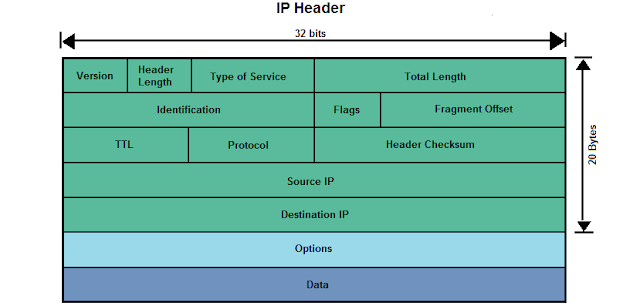
💡 IPv6 has a simpler header structure (fixed 40 bytes), removing unnecessary fields like fragmentation and checksums.
4. How IP Routing Works
IP packets don’t travel directly from sender to receiver. Instead, they pass through multiple routers, each deciding the next best path.
sequenceDiagram
    participant Device A
    participant Router 1
    participant Router 2
    participant Destination

    Device A->>Router 1: IP Packet (Dest = Destination)
    Router 1->>Router 2: Forward Packet
    Router 2->>Destination: Deliver Packet
Key Components of IP Routing
- 🔹 Routers – Devices that forward packets based on their destination IP.
- 🔹 Routing Tables – Each router maintains a table of known IP networks.
- 🔹 Hop-by-Hop Forwarding – Packets travel through multiple routers before reaching their target.
- 🔹 Time To Live (TTL) – Limits how long a packet can exist (prevents infinite loops).
5. Subnetting & CIDR: Making Efficient Use of IP Addresses
IP addresses are structured into subnets to improve efficiency.
Classless Inter-Domain Routing (CIDR)
CIDR replaces the old class-based system with flexible subnet masks:
| CIDR Notation | Subnet Mask | IP Range |
|---|---|---|
| /8 | 255.0.0.0 | 16.7 million addresses |
| /16 | 255.255.0.0 | 65,536 addresses |
| /24 | 255.255.255.0 | 256 addresses |
🔹 Example: 192.168.1.0/24 allows 256 IPs, commonly used in home networks.
6. Network Address Translation (NAT): Extending IPv4
To deal with IPv4 address exhaustion, NAT allows multiple devices to share a single public IP.
🖼 How NAT Works
sequenceDiagram
    participant Private Device
    participant NAT Router
    participant Internet

    Private Device->>NAT Router: Packet (Source: 192.168.1.2)
    NAT Router->>Internet: Translates to Public IP (Source: 203.0.113.1)
    Internet->>NAT Router: Reply Packet (Dest: 203.0.113.1)
NAT Router->>Private Device: Translates Back (Dest: 192.168.1.2)- 🔹 Types of NAT:
- ✅ Static NAT – One-to-one mapping between private and public IPs.
- ✅ Dynamic NAT – Assigns a public IP from a pool.
- ✅ PAT (Port Address Translation) – Multiple devices share a single IP using port numbers (most common).
7. IP Fragmentation & Reassembly
If a packet is too large for a network’s Maximum Transmission Unit (MTU), it gets fragmented.
1️⃣ Sender breaks the packet into smaller fragments.\ 2️⃣ Each fragment is sent separately.\ 3️⃣ The receiver reassembles the fragments.
🔹 Fragmentation overhead makes IPv6 avoid it entirely, relying on Path MTU Discovery instead.
8. The Relationship Between IP and Other Protocols
IP alone isn’t enough—it works alongside other protocols:
- 🔹 IP + TCP = Reliable Communication
- 🔹 IP + UDP = Fast, Unreliable Communication
- 🔹 IP + ICMP = Network Diagnostics (ping, traceroute)
🖼 Protocol Stack
graph TD;
    Application -->|HTTP, DNS, SSH| Transport;
    Transport -->|TCP, UDP| Internet;
    Internet -->|IPv4, IPv6| Network;
Network -->|Ethernet, Wi-Fi| Physical;Conclusion
IP is the foundation of the internet, handling addressing, routing, and delivery of data.
Key Takeaways
- ✅ IPv4 is still dominant, but IPv6 adoption is growing.
- ✅ Routers use IP to forward packets across networks.
- ✅ CIDR and NAT help optimise limited IPv4 addresses.
- ✅ IP fragmentation allows large packets to be transmitted.
- ✅ IP works closely with TCP, UDP, and ICMP for full functionality.
Every time you send an email, stream a