The Cone of Uncertainty: Why Your Estimates Are Always Wrong (And That’s Okay)
If you’ve ever been asked, “How long will this take?” and immediately felt a wave of dread, you’re not alone. Estimating software projects—or any complex endeavor—is notoriously difficult. The reason? A concept called The Cone of Uncertainty.
In this post, I’ll break down:
- What the Cone of Uncertainty is and where it came from
- Why early estimates are always wrong (and that’s fine)
- How to manage uncertainty instead of being blindsided by it
Let’s dive in.
What Is the Cone of Uncertainty?
The Cone of Uncertainty describes how the accuracy of estimates improves over time as more information becomes available. Early on, estimates can be off by as much as 4× higher or lower than reality. But as a project progresses, new insights reduce uncertainty, making estimates more reliable.
This concept was first introduced by Barry Boehm in the 1980s as part of his work on software engineering economics. It was later popularized by Steve McConnell in Software Estimation: Demystifying the Black Art. Since then, it’s become a fundamental part of how we understand software estimation.
Visualizing the Cone
Construx, Steve McConnell’s company, publishes a common diagram of the cone.
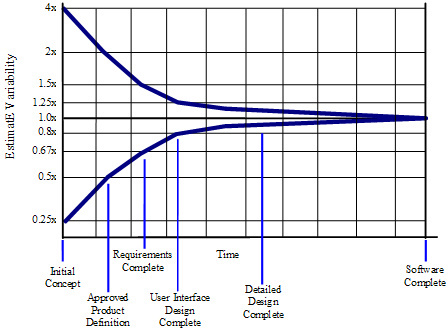
At the beginning of a project, estimates are rough—sometimes comically so. As you gain insights, uncertainties reduce, and your estimates become more reliable.
- 🔹 Project start: Estimates can be 4× too high or 4× too low.
- 🔹 Midway through: Refinements reduce uncertainty, but there’s still a margin of error.
- 🔹 Near the end: Estimates are much more reliable—though never perfect!
The Role of Unknown Unknowns
A big reason for early uncertainty is what former U.S. Secretary of Defense Donald Rumsfeld famously described:
“…there are also unknown unknowns—there are things we do not know we don’t know.”
Donald Rumsfeld, news briefing, 12 February 2002
At the start of a project, you’re often dealing with unknown unknowns—things you aren’t even aware will be a problem. As the project progresses, these unknowns gradually turn into known unknowns (risks you can account for) and then known knowns (things you fully understand).
This transition is what shrinks the Cone of Uncertainty.
Why Are We So Bad at Estimating?
Even the best engineers, project managers, and teams struggle with estimation. Why? Because at the beginning:
1️⃣ Unknown Unknowns Dominate – As discussed above, you don’t know what you don’t know.\ 2️⃣ Optimism Bias – People (especially stakeholders) prefer best-case scenarios.\ 3️⃣ Requirements Change – The project rarely stays exactly as envisioned.\ 4️⃣ Complexity and Dependencies – One “small” issue can cascade into massive delays.\ 5️⃣ Pressure to Commit – Once an estimate is given, it often gets treated as a deadline.
This is why so many software projects are late, over budget, or need to be drastically re-scoped.
How to Work With (Not Against) the Cone
Instead of resisting the Cone of Uncertainty, embrace it. Here’s how:
✅ Use Ranges, Not Absolutes – Instead of saying “This will take 3 months,” say “This will take between 2 and 6 months.” Acknowledge the uncertainty upfront.
✅ Reassess and Refine Estimates – As more information becomes available, refine your forecasts. Don’t let an early wild guess dictate later decisions.
✅ Communicate Uncertainty Clearly – Stakeholders need to understand that early estimates are just that—early. Help them see how uncertainty reduces over time.
✅ Break Down Work into Smaller Chunks – The smaller the task, the easier it is to estimate accurately. Use Agile methodologies to reduce estimation risk.
✅ Track and Learn from Past Projects – Keep historical data on how past estimates compared to actuals. Over time, this helps improve forecasting.
Final Thoughts
The Cone of Uncertainty is inevitable in software development (and beyond). The key isn’t to eliminate uncertainty (that’s impossible), but to manage it realistically.
So next time someone asks, “How long will this take?”—instead of giving a false sense of certainty, remind them:
"At this stage, we’re somewhere between a best guess and complete fantasy—but we’ll get better over time!" 😄